Making Complex Automation Feel Simple to Business Owners
Why this project needed more than a nice-looking website
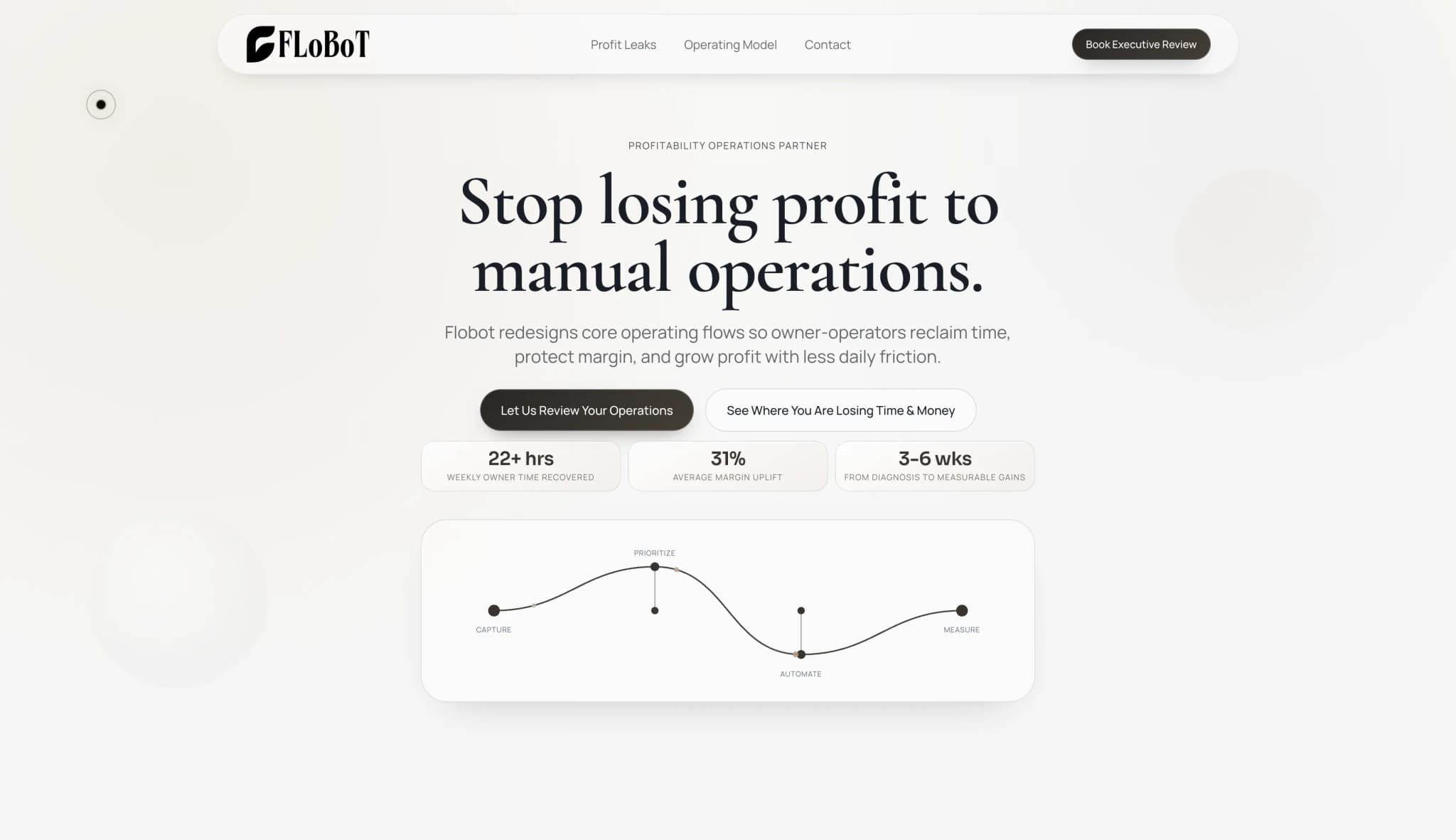
The web presence for a B2B workflow automation platform targeting profit-focused business operators. Designed to clearly communicate the product's value proposition to a non-technical audience, with modern UI, benefit-led copy structure, and strong conversion pathways. The brief sat in the saas / workflow automation space, which meant the work had to balance brand trust, clear user journeys, fast loading pages, and obvious conversion paths rather than relying on decoration alone.
My focus was to turn the business goal into a practical digital system: structure the offer, remove friction from the visitor journey, and make the next step feel natural on mobile and desktop. The deliverables included saas marketing website, benefit-led homepage, feature explainer pages, demo booking integration, each chosen because it supported a real commercial outcome.
The final result gave Flobot a stronger foundation for traffic, enquiries, and ongoing marketing. The clearest signal was +195% demo booking increase, backed by a cleaner page experience and a more focused conversion path.
The design work also had to respect how buyers behave in this niche. A visitor comparing saas / workflow automation providers needs quick context, visible proof, low-friction navigation, and enough detail to understand why the business is credible before they click away. That shaped the page order, copy hierarchy, visual rhythm, and calls to action.
From a technical and SEO perspective, the project needed a structure that could be maintained after launch. Clean sections, descriptive headings, optimised imagery, mobile-first spacing, and internal pathways all help the site support future campaigns instead of becoming a one-time design asset.
This is also why the case study matters for future buyers. It shows how the visible interface, the content strategy, the technical build, and the business objective fit together. For Flobot, the strongest decisions were the ones that reduced hesitation: clearer information, stronger proof points, easier navigation, and a more direct route from interest to action.
How and why we built it this way
Flobot's central challenge was communicating abstract software value to non-technical buyers. The previous site was structured like a product specification document — features, technical capabilities, and platform details that meant nothing to an SME owner who just needed to know if their current manual processes could be fixed. The redesign started from a different question: what does the visitor want to feel when they leave this page? The answer was 'this will save me time and I understand how.' Every section was built around a specific operational pain point — invoice delays, staff scheduling confusion, client follow-up gaps — with a visual process flow showing how Flobot addressed it. Pricing was made transparent, removing a common objection. The demo booking funnel was simplified from a multi-field contact form to a two-step calendar embed, reducing friction by removing the need to explain the request before seeing availability. The outcome was a site where the right audience — profit-focused SME operators — self-selected and converted at a rate that justified the traffic investment.
+195%
Demo booking increase
2.6×
Average session duration
0.9% → 3.4%
Conversion rate improvement
52%
Reduction in support pre-sales queries
Flobot had a powerful product but a website that read like a technical manual. Visitors — typically SME operators with no IT background — were failing to understand what the product did within the first 10 seconds and leaving immediately.
I rebuilt the site around benefit-led storytelling rather than feature lists. Each section was designed to answer one question: 'How does this save me time or money?' I introduced visual process flows, relatable use-case scenarios, and clear pricing — all culminating in a demo booking funnel.
Demo bookings tripled and the average session duration more than doubled, signalling that the right audience was finally engaging.
Deliverables
What is Flobot and what problem does it solve?
Flobot is a workflow automation platform built to replace repetitive manual operations in service businesses — things like data entry between systems, status update emails, report generation, and task assignment. Instead of building separate Zapier or Make automations for each workflow, Flobot provides a unified environment for managing all automation logic with visibility into what's running and what's failed.
How long does it take to build a custom automation platform?
A custom automation platform of Flobot's scope typically takes 16–24 weeks to build properly — backend architecture, workflow engine, frontend UI, testing, and user acceptance testing. Cutting this timeline produces systems that break under real usage conditions. Flobot was built over 20 weeks, with staged testing at each phase.
What technologies power a custom automation platform?
Flobot was built on Node.js and React with a PostgreSQL data layer, using a custom workflow engine with support for conditional logic, scheduled triggers, and webhook-based integrations. The platform integrates with common business tools via REST APIs and supports custom webhook endpoints for non-standard systems.
Can automation tools replace employees?
Automation tools replace specific tasks, not roles. The most successful implementations target the work employees don't want to be doing — data re-entry, routine status updates, report compilation — and free those employees for higher-judgment work. Flobot was built specifically for this use case: reducing the administrative overhead in service delivery so the team could focus on client work.
Want results like these
for your business?
Every project starts with a conversation. Tell me about what you're building.