Attracting Higher-Value Renovation Clients Through a Credible Online Presence
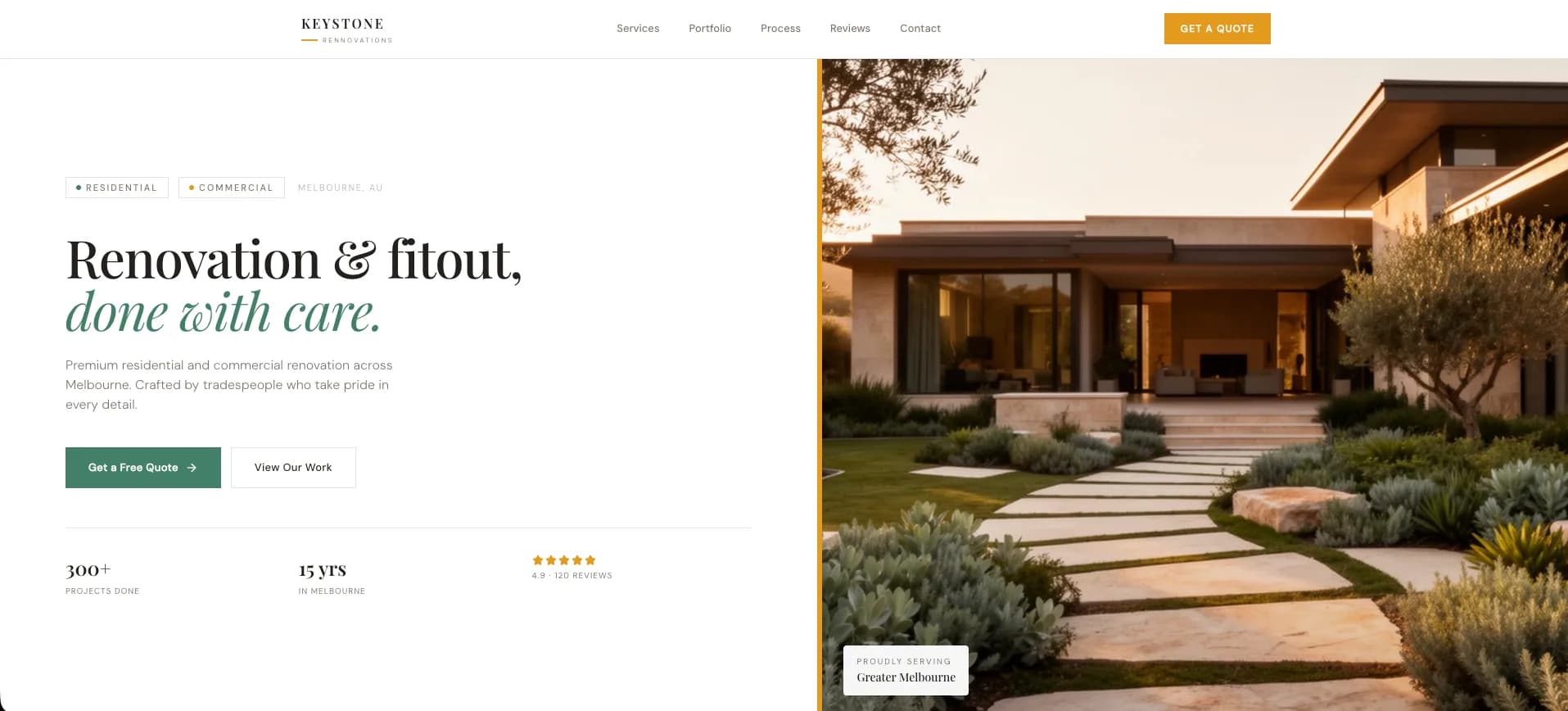
Why this project needed more than a nice-looking website
A service-focused website for an Australian renovation company, showcasing their work and services to attract homeowners looking for quality renovation contractors. Professional trust-building layout with clear contact pathways to drive enquiries. The brief sat in the home renovations & construction space, which meant the work had to balance brand trust, clear user journeys, fast loading pages, and obvious conversion paths rather than relying on decoration alone.
My focus was to turn the business goal into a practical digital system: structure the offer, remove friction from the visitor journey, and make the next step feel natural on mobile and desktop. The deliverables included wordpress website, project portfolio gallery, service landing pages, quote request forms, each chosen because it supported a real commercial outcome.
The final result gave KeyStone Renovations a stronger foundation for traffic, enquiries, and ongoing marketing. The clearest signal was +270% project enquiry volume, backed by a cleaner page experience and a more focused conversion path.
The design work also had to respect how buyers behave in this niche. A visitor comparing home renovations & construction providers needs quick context, visible proof, low-friction navigation, and enough detail to understand why the business is credible before they click away. That shaped the page order, copy hierarchy, visual rhythm, and calls to action.
From a technical and SEO perspective, the project needed a structure that could be maintained after launch. Clean sections, descriptive headings, optimised imagery, mobile-first spacing, and internal pathways all help the site support future campaigns instead of becoming a one-time design asset.
This is also why the case study matters for future buyers. It shows how the visible interface, the content strategy, the technical build, and the business objective fit together. For KeyStone Renovations, the strongest decisions were the ones that reduced hesitation: clearer information, stronger proof points, easier navigation, and a more direct route from interest to action.
How and why we built it this way
The renovation market is one where social proof is the primary conversion driver: homeowners are trusting a contractor with their home, their timeline, and often more than $50,000 of their savings. The design architecture for KeyStone was built around making that proof unmissable. Before/after project photography was placed at the top of the homepage — not buried in a portfolio section — because research shows renovation buyers make their evaluation almost immediately based on whether the quality of work matches what they're looking for. Service pages for kitchens, bathrooms, extensions, and complete renovations were structured to include specific project details rather than generic service descriptions: what KeyStone actually does at each project stage, how long it takes, and what a client should expect during the process. The quote request form asked specific questions — project type, budget range, timeline — so enquiries arrived pre-qualified and the sales conversation could start at a more advanced stage. Local SEO targeted service-area terms combining suburb names with renovation types, which produced the Top 3 Google rankings that now drive the majority of inbound project enquiries.
+270%
Project enquiry volume
76%
Of new project leads from website
+31%
Average project value
Top 3
Google ranking for local renovation terms
KeyStone Renovations was winning work through word-of-mouth alone. While the quality of their work was exceptional, they had no way to showcase it online — and homeowners searching for renovation contractors found competitors instead. Equally, their lack of digital presence was limiting the type of project they could attract.
I built a trust-first website centred around their project portfolio — before/after photography, detailed project descriptions, and service breakdowns for kitchens, bathrooms, extensions, and full renovations. Clear quote request forms were placed at every conversion point, and I executed local SEO to capture intent-driven searches.
Enquiry volume increased nearly threefold and projects shifted toward higher average values as more discerning clients started reaching out having seen their work online.
Deliverables
What does a professional services firm website need to communicate?
A professional services website needs to establish expertise and credibility before anything else. Visitors are evaluating whether the firm can solve their specific problem, so the site should quickly answer: what they do, who they do it for, what outcomes their clients get, and why this firm rather than alternatives. Keystone's brief required clear positioning, visible credentials, and a straightforward enquiry path — no friction between interest and contact.
How do you write website copy for B2B professional services?
B2B professional services copy works best when it's specific rather than generic — describing real client scenarios rather than broad capabilities, using the language buyers actually use to describe their problems, and backing claims with concrete outcomes rather than platitudes. Generic phrases like 'we deliver excellence' signal nothing; specific statements like 'we've helped 40+ logistics companies reduce customs delays' do.
Should a professional services firm blog or publish articles?
Yes — thought leadership content is one of the strongest SEO and trust-building mechanisms for professional services firms. Articles that answer the specific questions clients ask in meetings (How do I handle X? What does Y cost? When should I do Z?) rank for intent-driven searches and establish the firm's expertise before a prospect even makes contact.
How long does it take to build a B2B professional services website?
A properly built professional services site — custom design, clearly structured services pages, case studies or portfolio, and basic SEO configuration — takes 6–10 weeks. The main variable is copy: if the client provides well-structured copy in advance, the timeline compresses. If copy needs to be developed from scratch, add 2–3 weeks for content strategy and writing.
Want results like these
for your business?
Every project starts with a conversation. Tell me about what you're building.