Giving a Digital Agency the Website It Deserved
Why this project needed more than a nice-looking website
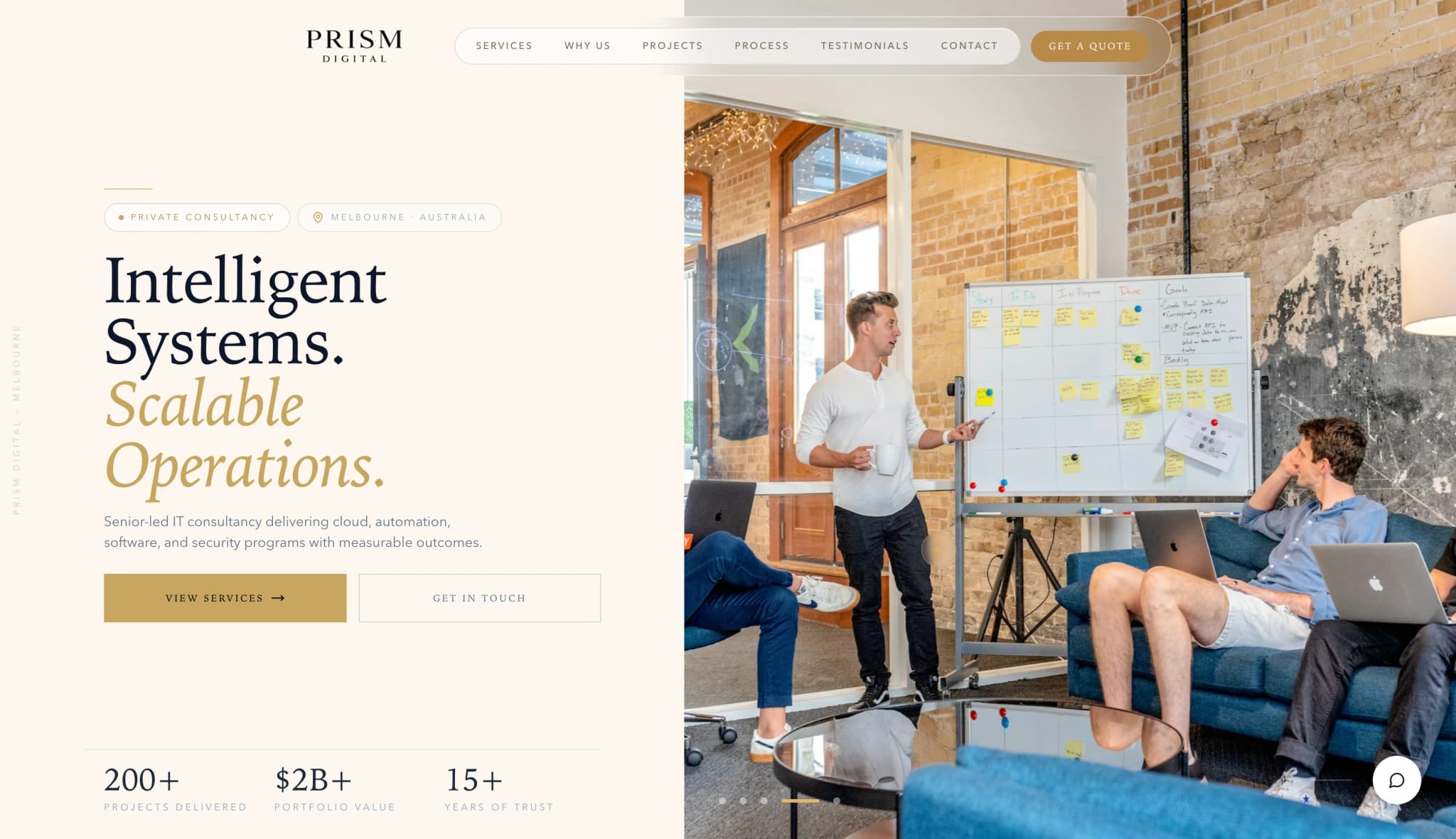
A website for an Australian digital marketing agency, helping them establish a strong professional online presence. Designed to reflect the agency's digital expertise with a modern layout, service breakdowns, and strong brand identity. The brief sat in the digital marketing agency space, which meant the work had to balance brand trust, clear user journeys, fast loading pages, and obvious conversion paths rather than relying on decoration alone.
My focus was to turn the business goal into a practical digital system: structure the offer, remove friction from the visitor journey, and make the next step feel natural on mobile and desktop. The deliverables included agency wordpress website, service pages, team & culture section, work with us funnel, each chosen because it supported a real commercial outcome.
The final result gave Prism Digital a stronger foundation for traffic, enquiries, and ongoing marketing. The clearest signal was 12 new retainer clients in 6 months, backed by a cleaner page experience and a more focused conversion path.
The design work also had to respect how buyers behave in this niche. A visitor comparing digital marketing agency providers needs quick context, visible proof, low-friction navigation, and enough detail to understand why the business is credible before they click away. That shaped the page order, copy hierarchy, visual rhythm, and calls to action.
From a technical and SEO perspective, the project needed a structure that could be maintained after launch. Clean sections, descriptive headings, optimised imagery, mobile-first spacing, and internal pathways all help the site support future campaigns instead of becoming a one-time design asset.
This is also why the case study matters for future buyers. It shows how the visible interface, the content strategy, the technical build, and the business objective fit together. For Prism Digital, the strongest decisions were the ones that reduced hesitation: clearer information, stronger proof points, easier navigation, and a more direct route from interest to action.
How and why we built it this way
An agency website is always being evaluated against a question that doesn't apply to other types of businesses: if they can't make their own website good, why would I trust them with mine? The Prism Digital build had to perform at a high standard as a standalone piece of design while simultaneously demonstrating the full range of the agency's capability. The homepage was structured as a portfolio-in-miniature: every section used a different layout format — alternating visual treatments, varied content hierarchies, mixed text and image compositions — to show range without sacrificing coherence. Case study previews were designed with enough specificity to be credible: specific outcomes, real metrics, named services. The 'Work With Us' section was engineered as a qualification funnel rather than a generic contact form — asking about budget range, service type, and project timeline to ensure that Prism's sales conversations started with pre-qualified leads. The LinkedIn lead impact came from the page's clear professional positioning, which made it directly sharable in professional contexts rather than requiring a pitch conversation to establish what the agency did.
12
New retainer clients in 6 months
+36%
Proposal acceptance rate
+29%
Average client project value
+185%
LinkedIn inbound lead volume
Prism Digital was pitching to clients about the power of great web presence — while their own site was outdated and failing to reflect their capabilities. The credibility gap was directly impacting proposal acceptance rates and average client value.
I built a sharp, modern agency website that demonstrated their expertise through its own design quality. Clear service breakdowns, case study previews, team sections, and a well-structured 'Work With Us' funnel. The site was treated as a live portfolio piece in its own right.
Within 6 months of the new site launching, Prism had signed 12 new retainer clients and their proposal acceptance rate increased measurably.
Deliverables
What does a digital agency website need to communicate?
A digital agency website needs to immediately answer: what work do they do, how good is it, and what's it like to work with them. The portfolio is the most important section — not what the agency says about itself, but what work it has actually produced. Prism Digital's brief was to create a site that let the work lead, with clean case study presentation and a positioning statement that differentiated them from generic 'digital marketing agencies.'
How should a digital agency structure its service pages?
Service pages for a digital agency work best when they describe specific outcomes rather than process descriptions. 'We run Google Ads' is table stakes — 'we reduced lead cost from ₹800 to ₹280 for an e-commerce client by restructuring their shopping campaigns' is specific and credible. Each service page should include what the service does for the client's business, what the process looks like, and at least one relevant case study or result.
How do you build a credible case study page?
A credible case study page includes: the business context and challenge, the specific solution implemented, measurable results (not vague improvements), and ideally a client quote or reference. The work shown should be recent and representative of what the agency actually does now — outdated or unrepresentative work does more harm than no portfolio at all.
What makes a digital agency website perform well in search?
Digital agency SEO requires targeting specific service + location terms ('Google Ads agency Chandigarh,' 'web design company India') with dedicated service pages, publishing regular thought leadership content that answers the questions clients ask before hiring an agency, and earning backlinks through industry presence. Prism Digital's site was structured with clear service page architecture and an optimised blog plan.
Want results like these
for your business?
Every project starts with a conversation. Tell me about what you're building.